

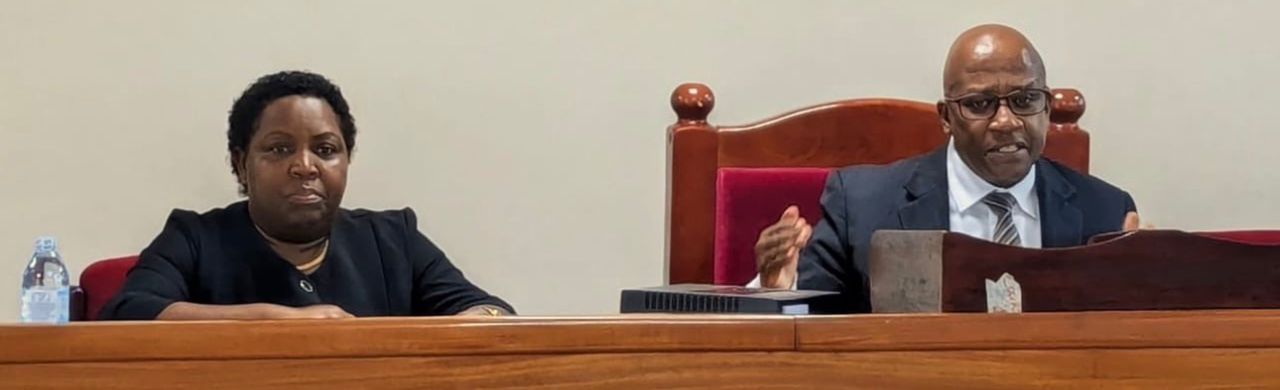
Facing a sustained surge in case volumes, the Family Division of the High Court is doubling down on mediation and digital reform as practical solutions to improve efficiency and reduce delays.
This renewed focus emerged during a Court Users’ Meeting held yesterday at the Division’s premises, where judicial officers, advocates, and justice sector stakeholders gathered to confront operational challenges and chart a more responsive path forward.
Presiding over the session, Justice John Eudes Keitirima framed mediation not just as an alternative, but as a necessary shift in how justice is delivered within the Division.
“Mediation empowers parties to control outcomes and reach mutually beneficial agreements,” he said, stressing that it reduces stress, preserves relationships, and offers flexibility that formal litigation often cannot provide.
Justice Keitirima’s remarks come amid mounting pressure on the Division’s workload. From January to March alone, the court carried forward 7,759 cases, registered 2,254 new ones, and disposed of 2,672—leaving 7,427 active matters. This translates into an average of over 700 cases per judicial officer, a figure he acknowledged cannot be sustainably addressed through traditional adjudication alone.
To bridge this gap, the Division has introduced a combination of targeted interventions. These include engaging approximately 15 court-accredited mediators, organizing backlog clearance sessions, and scheduling additional sittings where each judge will be assigned about 300 cases. The initiative is expected to significantly reduce pending applications, particularly those relating to extensions of grants.
In parallel, efforts are underway to streamline administration causes, with the Division aiming for same-day handling once matters are identified. Special attention is also being directed toward “critical backlog” cases—those pending for over five years.
Beyond case management, digital transformation remains central to the Division’s reform agenda.
With the Judiciary targeting full adoption of the Electronic Court Case Management Information System (ECCMIS) by July 2026, Justice Keitirima urged advocates to fully comply with electronic filing requirements and improve the quality of pleadings.
Reinforcing this direction, the Deputy Head of the Division, Lady Justice Immaculate Busingye highlighted that ECCMIS now has firm legal grounding, with recent High Court decisions affirming electronic service of documents as equivalent to traditional methods.
Lady Justice Busingye noted, however, that some practitioners continue to rely on outdated processes, particularly when filing new cases or seeking directions. To address this, the Judicial Training Institute continues to train both court staff and external users, while stakeholders such as the Uganda Law Society remain actively involved in refining the system.
Lady Justice Busingye acknowledged that resistance initially slowed adoption but emphasized that ECCMIS is now firmly established as the future of judicial operations.
Despite these reforms, stakeholders voiced persistent concerns during the meeting. Among the key issues raised were intermittent system functionality, delays in hearings and judgments, and communication gaps—especially in the absence of staff.
Participants also pointed to inconsistencies in scheduling hearing dates and delays in identifying and processing long-pending cases.
The engagement ultimately highlighted a justice system in transition—balancing heavy caseloads with reform efforts aimed at efficiency, accessibility, and sustainability.
With mediation and technology at the forefront, the Family Division signaled a clear intent to evolve beyond traditional models in delivering justice.
